
Amsterdam
By W. F. Twyman, Jr.

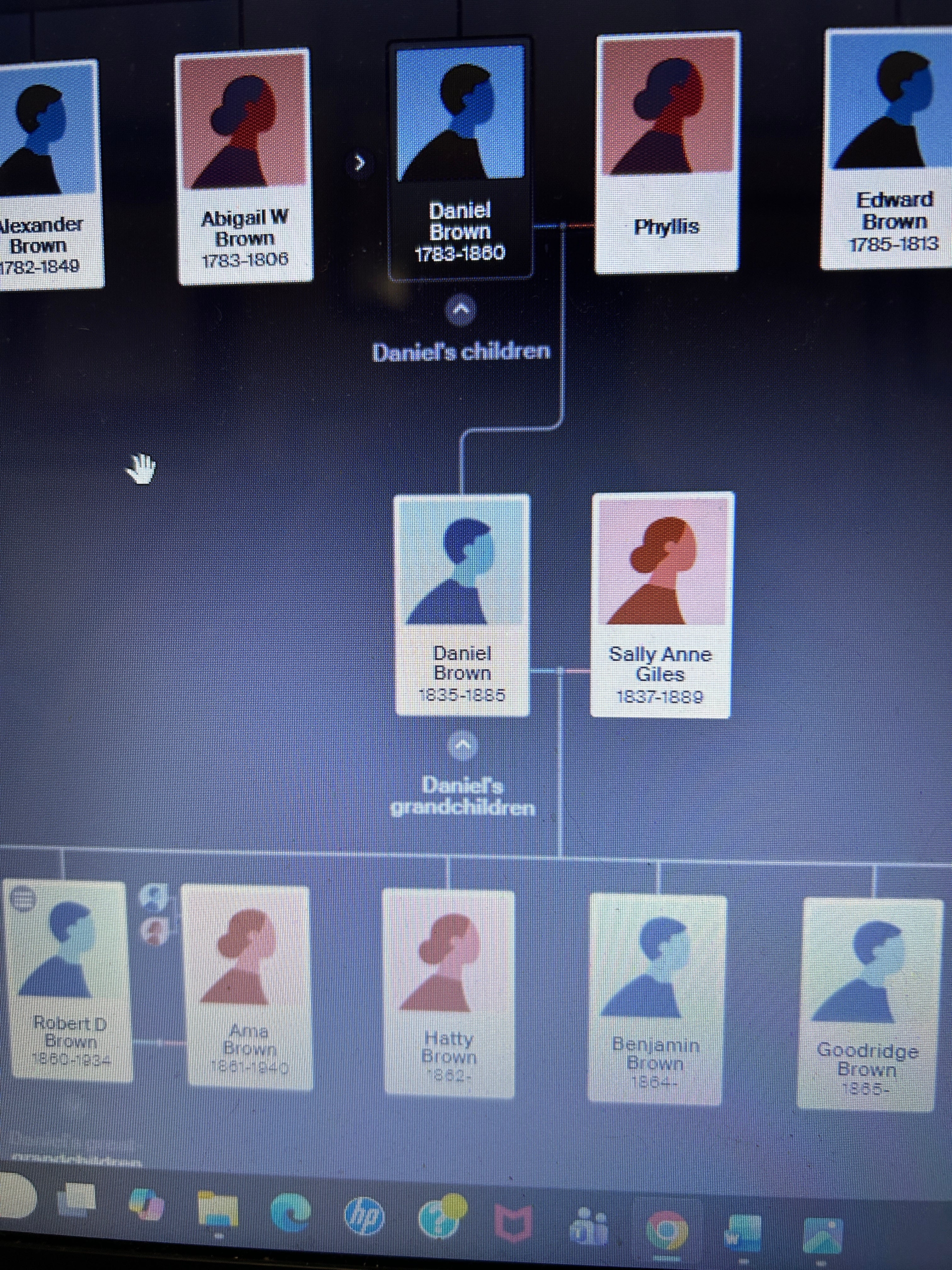
There are no surviving photographs of my Grandma’s Grandfather Daniel Brown (1835 - 1885). For hundreds of descendants, there have only been second-hand and third-hand descriptions of what Daniel looked like. He was the son of his slave master father Daniel Brown (1783 - 1860) and a light skinned slave named Phyllis. My Grandma once said her grandfather, who passed away nearly ten years before Grandma was born in 1893, was a short, dark-haired man with blue eyes. Family oral history records Daniel had no physical trait of his African heritage.
That is not much to go on for descendants. For over a century, we have been left to imagine Daniel in the flesh based upon fading black and white pictures of his children like my Grandma’s father, Robert Daniel Brown (1860 - 1934).
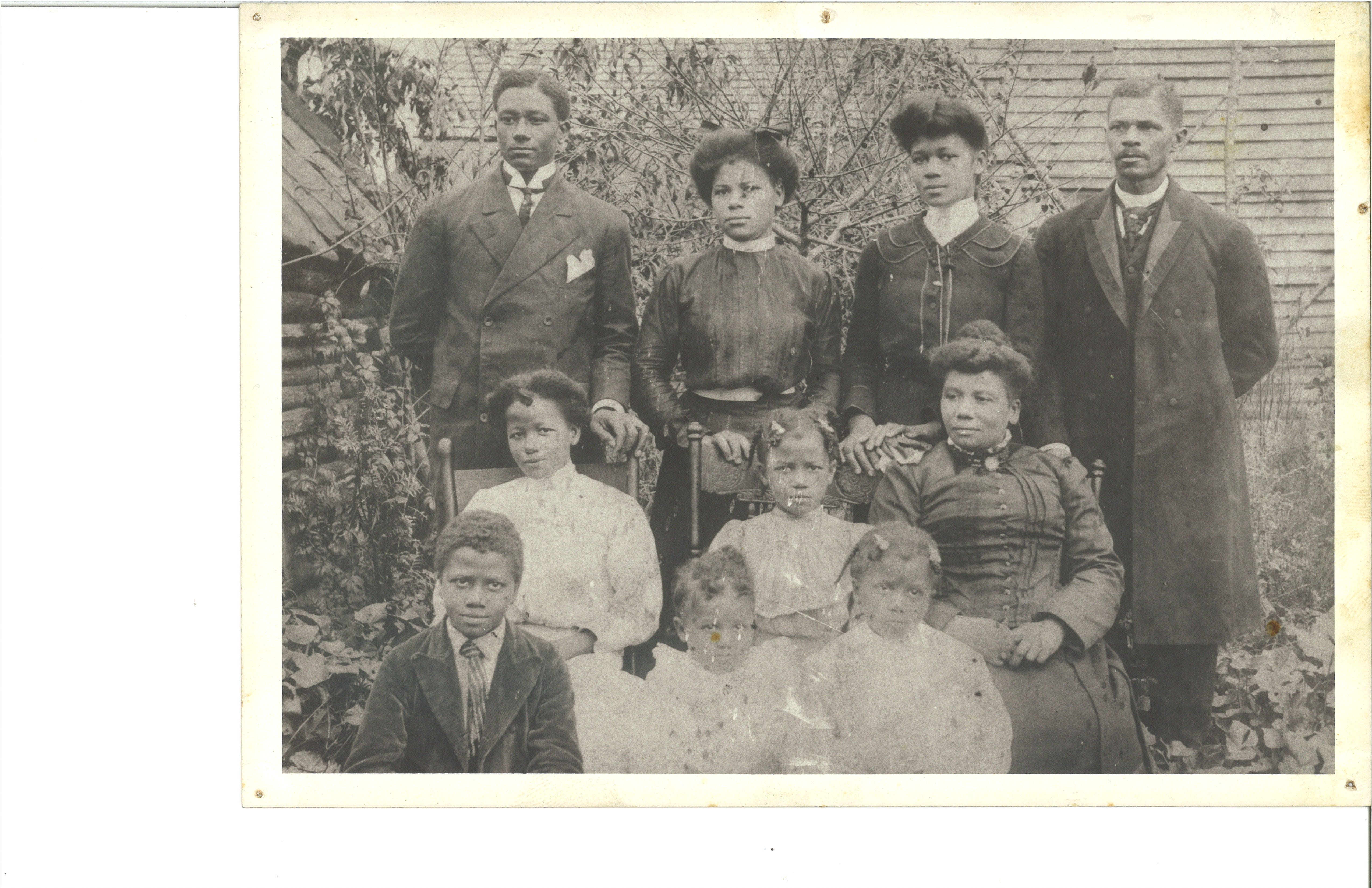
Robert Daniel Brown (1860 - 1934), Back Row and Far Right
My wife and I met my fifth cousin, Mark B., a few months ago on Coronado but so many years had come and gone since my Grandma’s Grandfather walked this earth. It was foolhardy to glance upon Mark’s face, handsome though it may be, and divine faint traces of my Grandma’s Grandfather’s face.
All was lost to the mists of time.
Last evening, however, I came a step closer to what my Grandma’s Grandfather might have looked like. I am always a curious man. I was strolling through Ancestry.com to update records. I thumbed through the TruLines function for Daniel Brown (1835 - 1885) and what did I discover? I found a family tree linking Grandma’s Grandfather to his father, Daniel Brown (1783 - 1860). And I scrolled more and more in excitement. I saw the name “Herbert Brown” which I recognized from family oral history and deeds of sale at the Virginia State Library. Phyllis had been won in a poker game as the two Brown brothers, Daniel and Herbert, defeated the Hamblin brothers.
And I noticed that Herbert had children. I hit the tab and up popped a black and white picture of a son of Herbert Brown, Pleasant Archibald Brown (1820 - 1890). I was gazing for the first time upon a picture of a white Brown genetic relation from the 1800s. I excitedly shared with my wife who was duly unimpressed. Curiosity has no place in the land of the unexamined life.
Well, I was excited. I was looking upon the face of Grandma’s Grandfather’s first cousin through Herbert Brown. At least now, I have a name and a face. These are small victories but, for those families lacking photographs from the 1800s, I can look upon a face and better imagine what Grandma’s Grandfather may have looked like in life. I can now compare the face of Daniel Brown’s son, Robert Daniel Brown (1860 - 1934), with the face of Daniel Brown’s first cousin, Pleasant Archibald Brown (1820 - 1890) It is better than nothing and I am grateful that the white Browns duly acknowledged a slew of black American cousins, including yours truly. These discoveries are rare for families descended from slaves.
We are one people and genetic genealogy will lead the way.
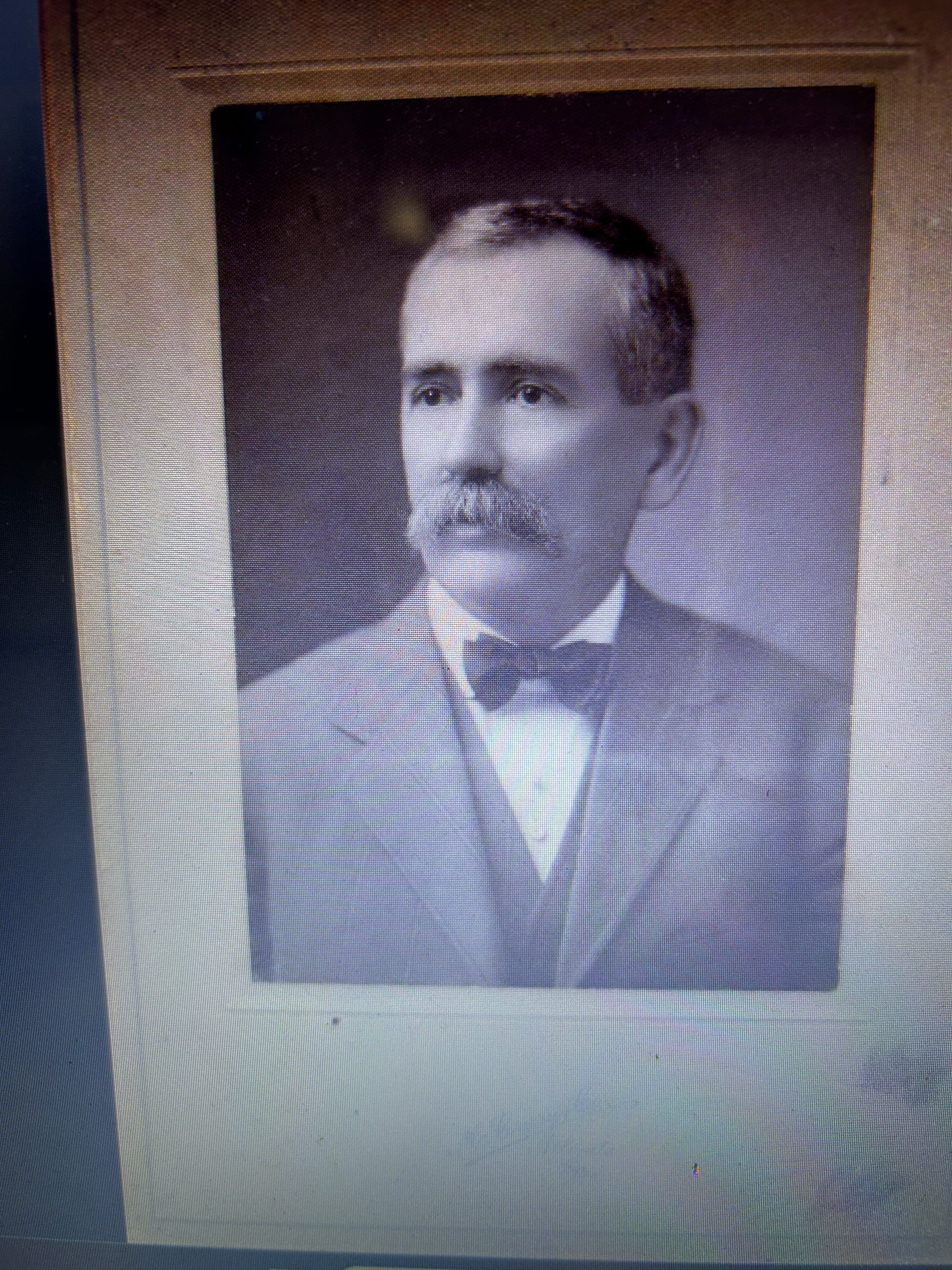
Pleasant Archibald Brown (1820 - 1890), First Cousin of My Grandma’s Grandfather Daniel Brown (1835 - 1885)
=========
As a recent podcast discussed
“Let’s talk about ancestry and the attempt of many people, many liberal types, to try and distance people’s grip, connection to their own ancestry and also to who your ancestors were, what they believed in, and why they would want to do something like that…” — He Who Controls the Past Controls the Present, The Podcast of the Lotus Eaters, December 22, 2025
Ancestry matters. It matters for you. It matters for me. Some Say the Left is Trying to Erase History
I entered the world as a blank slate. Before the age of three, I have no memory of anything. No family. No ancestry. No nothing. Thank goodness for a mother’s love and a father’s dutiful support. My neural pathways were receiving impressions every day of warmth and security. I didn’t know it but I was receiving an abundance of blessings from ancestors I knew not of. I was born American. I was native to Virginia, albeit Richmond with a troubled past. I entered the world as a Twyman brought home from the segregated colored hospital to Twyman Road where everyone was family.
My Grandma’s Grandfather, Daniel Brown (1835 - 1885), was an ancestor of vision and manifest destiny. Like founding fathers throughout history, his every measured move rippled through time for the benefit of future generations. I really get annoyed in my elder years when I read about blackness as oppression. Nothing else matters. I wish I could grab these doom and gloom writers by the collar and say Look here! I tell you, a black man of white appearance founded a black church, secured a mansion house for his growing black family, accumulated an estate of over 500 acres in two counties and left a will for his grieving widow. He lived with a mission in life, to be a good founding father for unborn generations!
Because my Grandma’s Grandfather moved through life with strength, my cousins and I came into the world with a leg up. That’s how winning is done, regardless of race and blackness. Just as he was, a former slave, my Grandma’s Grandfather was touched with a sense of destiny. I never knew Daniel Brown but I would walk through the church graveyard after sunday services and feel reverence for the tombstone of Robert Daniel Brown (1860 - 1934). I felt part of something larger than myself. My neural pathways were forever infused with pietas.
I cannot make it plainer for me and my life why ancestors matter. Ancestors matter.
Eighty years before I drew my first breath, you had laid the foundation for me and my family and my cousins. I never knew you in the flesh, but I grew up in the family church you founded. I began school on property you had once owned. Your echoes were ever present throughout Hickory Hill in the 1960s. And for all these blessings and much more, I give thanks to my grandma’s grandfather, our founding father, Daniel Brown . — Letters in Black and White: A New Correspondence on Race in America by Winkfield F. Twyman, Jr. and Jennifer Richmond, p. 358
=========
There is a reluctance among some black Americans to embrace and accept european ancestors. It is a pity and a consequence of low self-esteem, if not self-hatred. A healthy person accepts one’s genetic self. You would not exist but for all of your ancestors, regardless of race, coming together in love and in sin. The chromosomes that enable you to live may originate in Nigeria. They may also originate in the Netherlands. Every snp forms part of your genetic scaffolding. Remove one ancestor because you hate the european in your past and, poof, you are gone as a living creature.
Imagine how many black Americans walk around marinated in self-hatred, so much self-hatred they would rather die than know they have european in their ancestry. It is bonkers to me.
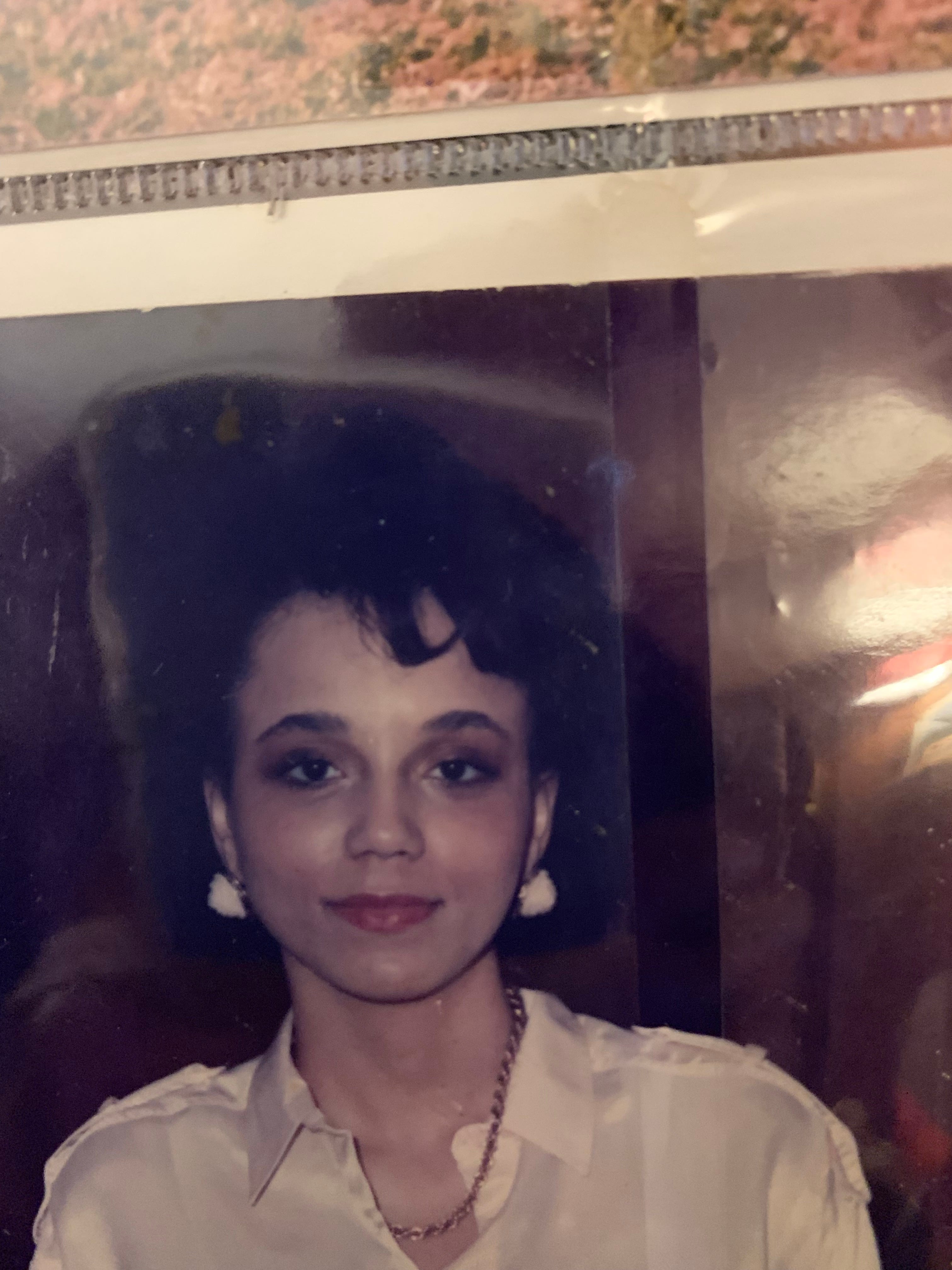
Beloved Cousin
Mini Me Beloved Cousin
I suspect leftists use this bias and prejudice against european ancestry to stir up racial divisions in the U.S. Otherwise, how could reparations work if every black American is also part slave owner in descent? More on this point later.
If one accepts that the genes of our Founding Fathers run in our veins, perhaps black Americans would feel more connected to the grand American story. For example, I have close family members who are descendants of the first colonial school teacher in Virginia in the year 1621. That genetic fact can be a tremendous source of connection and affinity for those who have open minds and hearts. It is also true which is the best part for national unity and common feel of kinship.
I urge all descendants of the Montague family in America to include your black American cousins in your family tree. We don’t bite (smile). And some of us share your pietas for our incredible common ancestor, Peter Montague II (1603 - 1659).
=========
My genetic ancestors are part of the wonderful American story dating back to 1621. When someone says ancestors don’t matter, my human feelings recoil in horror and revulsion. Of course, our ancestors matter and doubly so if our ancestors left their indelible imprint on the nation of my birth. I am a modest person. I do not like calling attention to myself which is an odd emotion as a writer. Dear readers, can you feel my emotion right here, right now? Our ancestors were beautiful and flawed and nuanced and complex. It is a human virtue to revere those who made our country possible.
Reluctantly, I share an honor roll of Twyman ancestors who earned the eternal right to be remembered by their countrymen. This honor roll comes directly from the herculean efforts of my genetics versed distant cousin, Dr. James Edwin Smith III. See Immigrations: Our family’s immigrations to America, from all over the world by J. E. Smith, III:
Peter Montague II (1603 - 1659) First school teacher in Colonial Virginia, 1621. p. 219
Richard Beaufort (1617 - 1677) Settled in Colonial Virginia in 1637. p. 227
George Twyman I (1663 - 1703) Settled in Middlesex County, Virginia in 1677. p. 138
Colonel Richard Lee (1618 - 1664) Settled in Colonial Virginia in 1639. p. 283 Wealthiest man in Virginia upon his death
Francis Lightfoot Lee (1734 - 1797) Signer of Declaration of Independence. p. 227
Richard Henry Lee (1732 - 1794) Signer of Declaration of Independence. Moved Resolution for American Independence on June 7, 1776. p. 227
Honorable Thomas Lee (1690 - 1750) Governor of Virginia. p. 227
George Twyman II (1698 - 1733) Middlesex County, Virginia. p. 227
George Twyman III (1731 - 1818). Revolutionary War soldier. p. 227
William Twyman I (1727 - 1811) Revolutionary War soldier. p. 227
James Twyman (1781 - 1849) Emancipated His Slaves by Will. p. 227
General John Thomas Buford, Sr. (1707 - 1787) General in the Continental Army. p. 237
Captain James Early Buford (1740 - 1792) Revolutionary War. p. 237
Captain William Early Buford (1745 - 1825) Revolutionary War soldier. p. 237
Colonel Abraham Buford (1749 - 1833) Revolutionary War soldier. p. 237
Captain Henry Buford (1751 - 1814) Revolutionary War soldier. p. 237
U.S. President Abraham Lincoln (1809 - 1865) Kept the Nation together during the Civil War. p. 256
General Robert E. Lee (1807 - 1870) Cast His Lot with Virginia During the Civil War. p. 283
U.S. President George Washington (1732 - 1799) The Uber Founding Father. p. 270
If one as a black American can desegregate family trees and embrace the fullness of one’s genetic ancestry, I suspect one would witness a renewed feeling of connection to the American story. One’s ancestors mattered to the American experience. One’s blood relations were making a way out of no way in the Virginia wilderness to bring this nation into existence. Leaders on both sides of the Civil War were distant cousins.
For me, the feeling of connection to these pioneers and leaders and founders runs deep. And that is a good thing if we are to think of ourselves as one people. Is it so hard to accept one is a Montague and embrace the crazy accomplishments of blood distant cousins? Maybe, it is more comfortable to view oneself only as related to slaves. The expectations for achievement are less in life.
What do you think?
=========
Some family members seem much more interested in their African blood kin from the sub-Saharan continent. Let’s talk for a moment about the mystical lost African cousins.
Since the year 2016, I have been on many genetic genealogy platforms — Ancestry, 23 and Me, Family Tree DNA, Gedmatch, Genomelink. I have reviewed the DNA matches for around 3,000 of my closest relatives world-wide. 40% of my genetic material comes from Nigeria. So, I was very keen to discover distant cousins who lived in Nigeria. My family members were highly interested in knowing who their people were in Nigeria. There was little interest in knowing their european antecedents.
After nearly a decade of searching, I can report a sad fact. There are zero DNA matches for me in Nigeria. Zero.
How can this be, you might ask? Surely, I must have hundreds of living cousins today in Nigeria. What gives? Here are my speculations.
First, there may be no interest in genetic genealogy in Nigeria. While black Americans feel this great ache to know lost kin in the motherland, I don’t sense there is a reciprocal feeling in Nigeria. Nigeria, in fact, is not a real country. It is an artifical creation formed out of the independence movement on October 1, 1960. Tribes mean far more to people than being a Nigerian. Is one an Igbo? Does one belong to the Fulani people? I sense this is how people roll in Nigeria.
Second, and as a result, black Americans are not on the radar screen. We are Americans first and foremost. We are foreigners. We are different. Skin color along means little, compared to our nationhood. If I am mistaken, please correct me.
Third, did you know over 525 languages are spoken in Nigeria? I grew up in a southern suburb where one langauge was spoken, English. These people in Nigeria are strangers to me. I have no sense of tribal affinities or loyalties. I can embrace being part Igbo and part Fulani as an American native to Virginia. I have no earthly clue what these loyalties mean on the ground in Lagos or northern Nigeria. Quite frankly, I am a native southerner. I have more in common with those in the Netherlands or England or Ireland.
Fourth, Ancestry tells me I am part Esan, Ibibio, and Idoma. These names mean nothing to me. It is like pulling names out of a hat. What language do they speak? I have not a clue. Would they hate the Igbo in me? The Fulani in me? Don’t know because these tribes are strangers to me. Sometimes, there is this feeling that black Americans must love their African roots regardless because of the evil slave trade. That doesn’t work for me. I can’t pretend to love tribes I have no knowledge of. And, in fact, these tribes might view me with a side-eye as a strange American. Worse yet, they might smell the Igbo and Fulani in me and cast me out as the enemy.
A close friend from the Jack and Jill crowd idealized Mother Africa. She wanted to spend time in Africa and rediscover her roots, her people. What happened? Well, my friend who is light-skinned and attractive was viewed as a white American by native Africans! So much for bonding. She returned to America a chastened woman.
Finally, I do bear affection for the Igbo and Fulani people. I love the Igbo people as they have a reputation for sharpness and high intelligence. Igbo students score some of the highest marks in schools in the United Kingdom. Works for me. And a sizeable number of Igbo people lived in Virginia. They had a serious reputation for resisting slavery which I appreciate. Too smart for dogma and slogan words (smile).
I have fondness for the Fulani people because of my Mom’s maternal haplogroup, L2a1. My Mom’s female ancestors in her direct female line were Fulani. And the Fulani originated from a Jewish woman in the Levant around 2,000 years ago. A great story of how the founding mother of Jewish faith would bear Fulani descendants, American slave descendants, my maternal Grandmother and my Mom. My Mom And Her Distant Mothers
One of my Jewish friends joked I was Jewish due to the female line. Well, that would be a great addition to my ancestral line. Ancestors matter as they connect us to the larger world.
=========
And this brings me to Cheddar Man. According to Genomelink, I am a direct descendant of the famous Cheddar Man. “Excavated in 1903, Cheddar Man is the oldest near-complete human skeleton found in Great Britain.” Cheddar Man lived around the years 8540–7990 BC and 8470–8230 BC. So, it is no big deal to be a descendant of Cheddar Man. I did notice how the media desired to paint Cheddar Man as having dark skin. I’m not sure I buy the dark skin depiction. I am supicious and would like contemporary DNA analysis to be conducted. But ultimately does it matter what Cheddar Man’s skin color was? Did Cheddar Man care about skin color in his place and time? The media’s excitement about discovering a direct descendant of Cheddar Man intrigued me. A nice Englishman living in the countryside two miles or so from the remains.
No one reached out to me as a direct descendant of Cheddar Man…hey BBC, how about me, yeah me, out here in San Diego.
Does having Cheddar Man as an ancestor matter? Not really. The distance is too remote, although wouldn’t it be nice to profile non-English descendants of Cheddar Man to show how connected we all are?
Although my bloodline is around 78% subSaharan African, one would not know it from my matching ancient bloodlines. Genomelink has put together a listing of DNA matches between me and ancient remains found throughout the world. Out of 566 samples, I DNA matched perhaps three remains from Africa. And these matches were not very close. My closest matches out of 566 ancient samples were as follows:
1.Sardian Woman Wrapped in Shrouds — 0.8% DNA match — Alghero, L’Alguer, Sardina, 8th century B.C.
2. Pottery Maker from Japan — 0.25% DNA match — Rebun Island, Hokkaido
3. Man from Roman Empire — 0.22% DNA match — Rome Italy, Year 0 - 32
4. Coastal Cavewoman — 0.013% DNA match — Sicily, 13,800 to 14,200 years ago
5. Origin of Modern Morocco — 0.11% DNA match
What do I make of these surprising DNA matches to ancient bloodlines? First, climate conditions were not conducive to preservation of ancient remains in sub-Saharan West Africa. Second, I am truly a citizen of the world as are most people in the modern West. Third, there is a strange concentration of close DNA matches centered in the Mediterrean world. This concentration aligns well with my closest paternal haplogroup matches on FamilyTree DNA. My closest paternal matches in a direct paternal line are found in Puerto Rico, Italy and Serbia. Fourth, these results force one to be accepting of everyone and all peoples throughout the globe. One may be of mostly Nigerian heritage while, at the same time, the genetic material of an unknown pottery maker in Japan lives on in one’s body. Finally, the caves saved our ancient ancestors from extinction. I remember my Coastal Cavewoman ancestor with reverence and pietas. The Human Condition
=========
Before I conclude this essay about connection to the larger world and why ancestors matter so much, I would be remiss if I did not use this material to launch another round against reparations for American slavery. Where shall I start?
Every reparations proposal presumes applicants must produce documentation to show lineage from a slave. And on its face, this requirement is a sound protection against fraud. Although shouldn’t the paperwork requirement require more than just one slave ancestor? If the typical descendant of American slaves has eight greatgrandparents, shouldn’t the documentation require that a majority of the eight greatgrandparents were slaves? Wouldn’t that make more sense than allowing a descendant to slip under the wire with one slave greatgrandparent out of eight greatgrandparents?
I am going to press this point since documentation of slave ancestry is essential for any reparations scheme to work. Let’s take me. I am more interested in genetic genealogy than the average bear. How much documentation in my family tree can I produce of slave ancestors versus non-slave ancestors? What might I find?
Admittedly, my family tree is a work in progress, unlike the family tree of Cousin Jimmy which includes over 40,000 ancestors. My tree is far more modest. However, a clear pattern emerges. I have arguable documentation for the slave status of around 34 ancestors since 1607, the founding of Jamestown in Virginia. My family tree expands to records for around 125 non-slave ancestors (all white presumably). Out of 159 ancestors I have recorded, only 21.38% knew slave status in their lives. The remaining 78.62% did not.
Should those percentages matter when it comes to a documentation requirement for reparations for American slavery? Does the 78.62% non-slave documented ancestry trump the 21.38% documented slave ancestry? Why or why not? Admittedly, there were many more slaves up in the family tree but I lack the documentation. God bless any reparations commission staffer tasked with documenting all of my slave ancestors since 1607.
Good luck with that!
Conclusion: As a writer, we choose titles to capture the feeling tone of an essay. This essay’s title came to me this morning while I stood in my younger son’s room. There was a big picture on the wall. A lovely picture of some city by a canal. I had seen the picture for nearly a decade but had forgotten its origins.
“What is this picture of?” I asked my wife. She was just waking up.
“Oh, that’s Amsterdam. M. was over there and he took a picture of the view. I loved it and found a huge frame online.”
In that moment, Amsterdam pulled me in. It was in Amsterdam that M. fell in love with the Netherlands. It was in Amsterdam that two young people I know felt most in love. While in Virginia last month, I learned from my first cousin Robert that his father had two Dutch children by a Dutch woman. He has a half-brother and half-sister who are Dutch. I have first cousins who call the Netherlands home. I learned earlier this week that 8% of me comes from the Netherlands.
And as if that were not enough, I discovered 90% of my genes from the Netherlands come from my Dad. Nearly 100% of my Dad’s Chromosome18 originated in the Netherlands. And Chromosome 18 may be linked to autism. I prefer the word “quirky.”
Connect the dots, as my daughter said, yesterday.
Ancestors matter.


(
So cool you found a similar picture and are connecting these dots. Love learning abt my family
Interesting …