
Gideon's Trumpet
By W. F. Twyman, Jr.

“The most interesting thing about Gideon was his appearance. For the life of him, James did not see any African in Gideon. His hair was straight and blond. His skin was white. His eyes were blue. His nose was Roman. His lips were Nordic. And yet the colored came out in Gideon in his laughter, his turns of phrases, his memories of life on his father’s plantation, his sensitivity to Negro folkways. It was as if Gideon was born to show us one cannot judge a book by its cover. This part of Gideon’s character most intrigued James.” — Gotterdammerung, Chapter 46 An Old Vermont Bible (Oct. 2, 2024)
In creating a fictional world for the first black lawyer, I was drawn to a character like Gideon. I felt a compulsion to imagine an archetype, a character whose physical appearance bore no relation to one’s inner sense of self. The story of black Americans has always included the ambiguous. These are the ancestors like P.B.S. Pinchback, Norris Wright Cuney, Congressman Thomas E. Miller, Walter White and my Grandma’s Grandfather, Daniel Brown, who remained black during a nadir for black people as a group. None of these men bore visible trace of their African heritage. And yet they all to a man gave their life in service of black men and women.
To use an old phrase, they were Race Men.
At a surface level, I modeled Gideon loosely upon Gideon Quarles, the brother of John Mercer Langston. Gideon bore a strong resemblance to his white father and assumed the family name of his father, Major Ralph Quarles. Gideon worked as a free black barber in Chilicothe, Ohio even as faint whispers of African ancestry remained on his person. The racial ambiguity of Gideon’s life in Lousia County, Virginia and Chilicothe, Ohio intrigued me. His story was a piece of the first black lawyer’s story in my view.
My fictional Gideon became the manager of the barber shop inherited by Mary Twilight Scott, the widow of Ted Scott.
In Jungian psychology, there is this idea of universal patterns in the human condition “(Carl) Jung believed that there are universal experiences that are inherent to the human experience, such as belongingness, love, death, and fear.”
Similarly, there are universal patterns in black American culture and consciousness that are inherent to the human experience. One common pattern is the black American of european appearance who is anchored in deep, rich black self-identity. This archetype is innate to my known black American experience. This pattern enters my consciousness and the consciousness of innumerable others of the black American condition.
It is a univeral organizing them or pattern. Ergo the real Gideon Quarles resonated with me at the level of a racial archetype and thus found its way into my fictional character Gideon.
What caused me to write this essay this evening? Did something activate the Gideon archetype for me? Yes, something did. It was a moment of synchronicity.
As I researched links on Howard University President Mordecai Johnson for my upcoming AI essay with Michael Bowen, I began to feel more and more the power of Johnson’s vision for Howard in the 1920s. It was as if his voice as a Baptist pastor swept across the American landscape. He was a true titan in the wilderness of despair. I began to wonder what did he sound like? Arguably, one of the greatest black pastors in the early 1900s and yet there are precious few recordings of his words.
I dug deeper and found an amazing contemporaneous account of Rev. Johnson from 1927. A white listerner knew nothing of Johnson beforehand, save his reputation as an orator and pastor and newly-selected president of Howard University. The man began his account in mild disbelief that Johnson was a Negro. His features were european. There was no curl at all in his hair. His skin barely registered color. The writer felt one would have no basis to believe Johnson was black upon sight.
Then, the man’s perception changed upon hearing the speech of Johnson. The writer fawned over the power of Johnson’s oratory, his “deep, mellow voice that is the Negro’s heritage.” And in that moment, I felt Gideon’s trumpet. I felt blackness revealed, not through physical apperance, but trumpted from a voice born of a black home and black parents and the black church and black colleges. Johnson himself was the son of a black Baptist preacher. It was like how my James Moore Scott character in Gotterdammerung described the revelation of blackness in Gideon, the barber.
I don’t believe in cariatures and stereotypes. I do believe my own ears. I can hear the cadence of a black Baptist pastor from small-town Tennessee and Charleston, West Virginia in the early 1900s. Listen to a few moments of President’s Johnson’s oratory and tell me whether you hear a southern preacher man of black heritage as well.
https://blogs.loc.gov/teachers/2019/08/the-1957-march-on-washington-a-pilgrimage-for-rights-and-the-ballot/
Voice of Howard University President Mordecai Wyatt Johnson, Listen to 22:52 - 23:13
Conclusion: I have always respected those black Americans who respected themselves. They may not have looked the part but they chose to be true to themselves. Howard University President Mordecai W. Johnson strikes me as another Gideon-like figure from our national past. President Johnson brought european features to black American culture and consciousness. From 1926 to 1960, Rev. Johnson may well have been the leading black pastor and visionary before Dr. Martin Luther King, Jr.
Why is the first black president of Howard University not remembered in classooms? Could it be because we prefer our black leaders to be brown and dark-skinned? Might it be that President Johnson doesn’t fit the activist mold as a visionary college president? Do black Americans not value intellectuals and scholars as cultural leaders?
I don’t have definitive answers and it is late. I do observe that, once upon a time, those of european features were warmly accepted into the tent of black American leadership. My Grandma’s family was founded by a grandfather who had no physical trait of his African ancestry. My wife’s family at the level of great great grandparents are heavily white and european in appearance. This is not the case today. Why would a black American family lose european features over the generations? Should we care or not?
Gideon’s trumpet is a metaphor. There is a place in our pietas for those of soulful voice who may not look the part.
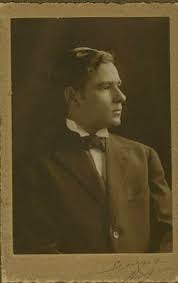
A Young Mordecai W. Johnson